
It is officially 2026, and if you feel like you’re suffering from “agentic AI fatigue,” you aren’t alone. We’ve been told that AI agents are the “sovereign employees” of the future. But the reality is far from our predictions, for most enterprises feel stuck or the AI future graph is a bit… static.
We have a paradox. On one hand, agentic AI adoption has hit 35% in just two years. That is an insane pace. To put it in perspective, traditional AI took eight years to get there, and even the generative AI explosion needed three. We aren’t just adopting; we’re inhaling this technology.
Despite the 95% of organizations reporting business growth from automation this year, most agents are still just “chatbots in a suit”, summarizing emails or answering FAQs instead of handling mission-critical cases.
The truth? We’ve reached the “Vision-Reality gap.“ We know the impact is enormous, but we’re paralyzed by the structural “attic” of our own making.
Source: Camunda
The Structural Moat: Why Some are Sprinting While Others Crawl
Why is the adoption pace so uneven? It comes down to the automation advantage. If your organization spent the last five years investing in IT modernization, cloud platforms, and data governance, you are currently layering Agentic AI on top of a solid foundation. You’re moving from pilot to ROI in 90 days.
But if you are still managing legacy monoliths, you’re starting from a massive disadvantage. This has created a structural competitive moat. Early movers aren’t just faster because they have more money; they’re faster because their “digital house” is clean. In 2026, your legacy system isn’t just a technical debt, it’s an anchor preventing your AI agents from ever leaving the harbor.
The Trust Crisis: Why 80% of Agents are “Siloed Toys”
Here is the elephant in the room: 84% of leaders are terrified of the business risk. We are deploying AI agents faster than we are creating the compliance frameworks to regulate them. Think about it: using agentic process automation we can execute thousands of decisions daily across multiple departments without a single human review. Traditional governance was built for humans and “If-This-Then-That” software. It was never meant for autonomous reasoning.
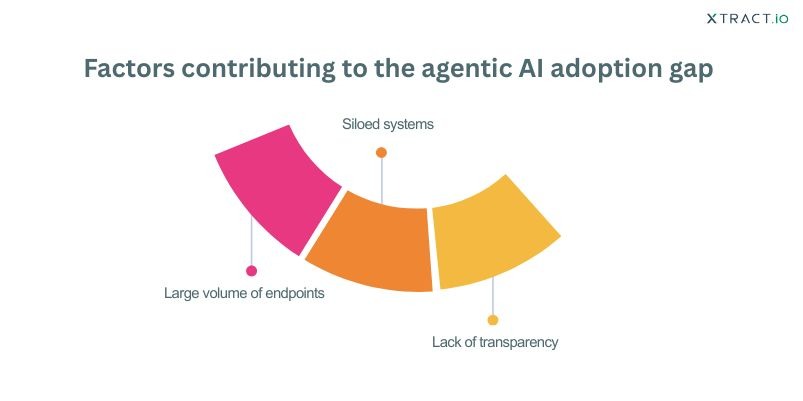
This has led to a massive adoption-governance gap:
- 80% of agents are siloed: They are relegated to “low-risk” tasks like summarization because we don’t trust them with the “keys to the safe.”
- The transparency blackout: 80% of leaders are concerned they don’t actually know how their AI is making decisions.
- The endpoint explosion: 76% of organizations say the volume of endpoints (where AI needs to interact) is growing exponentially, however 85% admit they don’t have the tools to manage the “intersections” between these processes.
The result? We are “fanning the flames” of poorly implemented processes. If your manual process is broken, adding an autonomous agent just makes it broken faster.
The Solution: Agentic Orchestration (Not Just “More Agents”)
If you take one thing away from this, let it be this: Agentic orchestration, not standalone agents, is the key to closing the gap.
We need a new operating model that blends deterministic orchestration (the rigid rules that keep you compliant) with dynamic reasoning (the agent’s ability to adapt in real-time).
CX leaders are declaring this from the rooftops: 91% agree that guardrails are the only way to protect brand reputation. We need to move away from “siloed copilots” and toward a governed multi-agent ecosystem.
The 2026 Checklist for Trust:
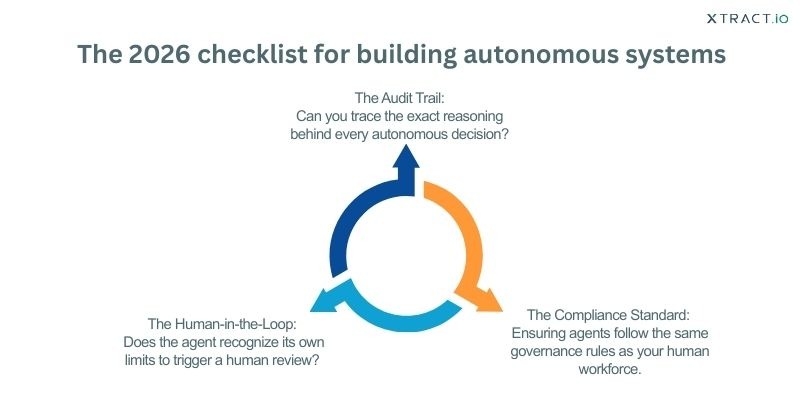
Visibility: Can you see exactly why the agent made that $50k refund decision?
Compliance: Does the agent follow the same regulatory rules as your human staff? (87% of CX leaders say this is their #1 worry).
Human-in-the-Loop: Does the agent know when to stop and ask for a “validation” to intervene?
Debunking the “Sentience” and “Replacement” Myths
While we’re fixing the structure, it’s time to clear the air on the hype.
- Myth: Agentic process automation is sentient. It isn’t. It’s a sophisticated pattern-matcher. It doesn’t “know” your company values; it predicts the next likely word. As researchers like Emily Bender point out, we often project “intent” onto these systems where none exists.
- Myth: It will replace all jobs. Agentic AI lacks human judgment, nuance, and genuine curiosity. Without humans, a company’s innovation will stagnate. We don’t need fewer people; we need AI workforce managers, a role 28% of you are already looking to hire.
How XDAS Closes the Gap
At Xtract.io, we’ve been watching this “gap” widen for years. That’s why we built the XDAS specifically to be the bridge.
We don’t just give you “an agent” instead you the controlled agentic process automation that has a governance-first approach.
- Solving the searchability crisis: Remember that “attic” problem? XDAS specializes in making your data searchable and reusable (the two biggest reasons 40% of projects fail). We turn your legacy data into a high-quality “ground truth.”
- Unified orchestration: We manage the “intersections” that 85% of you are struggling with. XDAS orchestrates the flow between AI agents, legacy systems, and human workers in one transparent pane of glass.
- Guardrails by design: We provide the transparency and audit trails that allow you to move your agents from “answering questions” to “handling mission-critical cases.”
The Bottom Line
Truth to be told, there is no more time for AI experimentation. The era of enterprise agentic automation is here.
The businesses that rule over in 2026 won’t be the ones with sophisticated technologies. They will be the ones who built a foundation of trust, cleaned their data house, and implemented an orchestration layer that keeps their agents on the tracks.
Stop letting your agents stay at the “edge” of your business. It’s time to move them into the core.