
In 2026, the “low-code development” officially moved past the honeymoon phase. It’s no longer a shiny toy for startups or a “quick fix” for minor IT backlogs. It is now the primary baseline for staying competitive.
If you’re sitting in a leadership chair today, you’re likely staring at a math problem that simply doesn’t add up. You have a global shortage of over a million developers, legacy systems that eat 80% of your budget just to stay “on,” and a business side that needs digital solutions yesterday. This is where the story changes. In 2026, low-code development platforms shouldn’t focus on “speed”; instead, they should focus on reclaiming process efficiency.
The 2026 low-code scenario: By the numbers
I’m a big believer in data because it cuts through the corporate fluff. If you want to know why your competitors are suddenly moving three times faster than you, look at these benchmarks:
The 75% rule: Gartner was right, roughly three-quarters of all new enterprise apps are now built on low-code no-code stacks. If you’re still hand-coding every internal portal, you’re likely overpaying by 300%.
About 80% of creators in the enterprise today aren’t in IT. They are HR leads, supply chain managers, and marketing leads.
81% of companies now list low-code as their most critical strategic asset for 2026. It has moved from the “experimental” bucket to the boardroom table.
The “vibe” shift in coding: How low-code AI changed the culture
The most profound change this year isn’t a new button or a prettier UI. It’s the move toward intent-based creation. We used to call it “drag-and-drop,” but not anymore; now it is vibe coding.
You just have to sit down and describe the outcome you need in plain English, like: “I need an automated reconciliation tool that flags invoice discrepancies and pings the vendor via email.” Here, the AI will not give you a template; it will draft a data model, suggest the interface, and stitch the APIs together. You aren’t “coding” in the old sense, you’re directing.
This is why platforms like the Xtract Data Automation Suite (XDAS) have become essential; they provide the “intelligence engine” that translates these natural language vibes into functional, data-driven workflows without the technical friction. At XDAS, we have FlowPilot, which can help you build complex workflows by just chatting. One moment you are describing your goal, and the next moment XDAS builds your low-code workflow in minutes.
Moreover, this landscape is moving so fast that ignoring even one of these shifts is like leaving money on the table.
The 5 low-code trends that actually matter right now
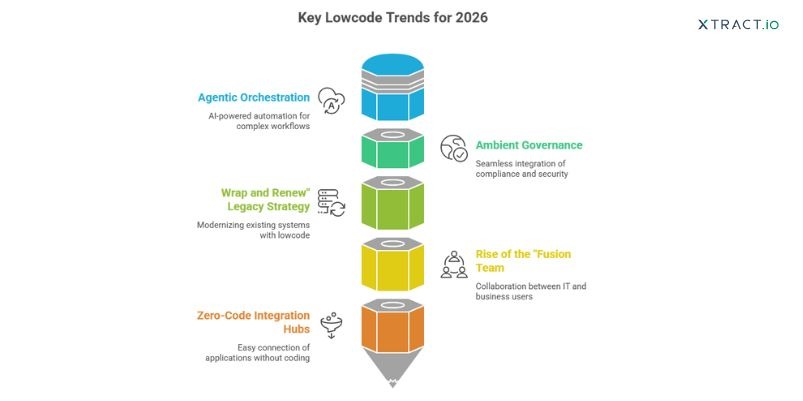
1. Agentic orchestration (beyond simple bots)
We’ve moved past basic “if-this-then-that” automation. Today, low-code development platforms host AI Agents. These aren’t just scripts; they are goal-oriented teammates. They monitor your data, make autonomous decisions, and only tap you on the shoulder when they hit a grey area. This is where automation finally becomes autonomy.
2. Ambient governance: (safety without the red tape)
In the old days, giving everyone low-code tools was a security nightmare. Now, we have ambient governance, meaning AI-powered guardrails that run silently in the background and step down immediately when there is a discrepancy. If a marketing intern accidentally tries to connect a database of customer emails to a public-facing tool, the system kills the connection instantly. It’s security that doesn’t wait, but acts.
3. The “wrap and renew” legacy strategy
The “old rip-and-replace” projects of the past were expensive disasters. In 2026, the smart move is incremental modernization. Fortunately, low-code is now the #1 tool for legacy modernization. Even with 20-year-old COBOL (Common Business Oriented Language) or Java systems, companies are using low-code development platforms to build modern “front doors” for these monoliths, extending their life while providing a 2026-grade user experience.
4. The rise of the “fusion team”
The wall between “The devs” and “The business” has finally blurred. The best apps today are built by hybrid teams: a pro-coder handling the complex API architecture and a business lead handling the user experience, all working in the same visual environment. It turns out, when people talk to each other, siloes are broken, and the software actually works.
5. Zero-code integration hubs
Building applications is one thing, but to integrate with existing systems is the hardest part of any project. Now, it’s table stakes. With standard protocols (like the Model Context Protocol), low-code development platforms now “talk” to SAP, Salesforce, or your custom local database instantly.
To be precise, we’ve finally entered the era of the “composable enterprise.” XDAS simplifies this further with its library of 300+ pre-built micro-solutions, effectively acting as the universal plug for your enterprise ecosystem.
The reality: What websites with fancy UIs won’t tell you
I want to be real with you: this transition isn’t all magic and rainbows. If you’re leading this shift, you’re going to hit some very human walls. Beyond the technology itself, the real value of no-code platforms lies in the cultural shift and the people who use them.
The architecture trap: Just because you can build an app in a day doesn’t mean you should. Every idea needs to be systematically evaluated based on different parameters to even consider automating that particular process; if not, you will end up with multiple disconnected tools that cannot deliver the desired outcomes your stakeholders will love.
The governance gap: Scaling AI agents without strict controls invites “agent sprawl.” CIOs in 2026 are spending more time on policy as code than they are on actual development.
Cultural resistance: Upgrading from a “ticket-based” IT culture to citizen developers is not a systemic change, but a cultural shift. We need to break the old mindset at an organizational level; the developers must position themselves as enablement leaders rather than just efficient coders.
A leader’s path forward to low-code development platforms
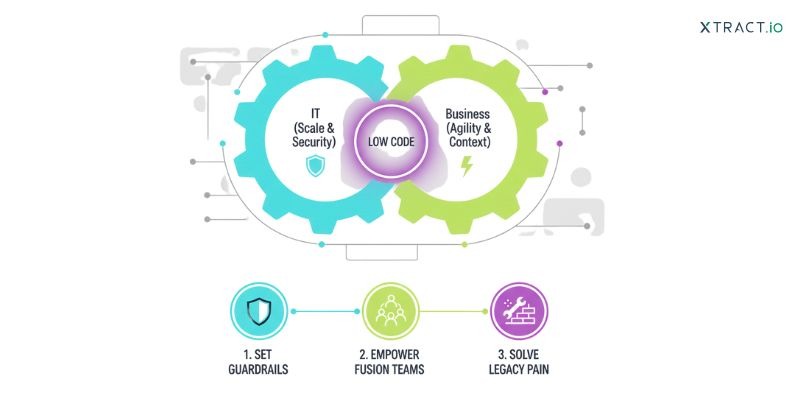
As we move through 2026, the divide between the leaders and the laggards is growing. The leaders aren’t just using “low-code tools”; they are building a digital agility layer that allows their business to pivot in real-time.
What you must consider today:
Prioritize governance over speed: Build your “Guardrails” first, then give everyone the keys.
Invest in “fusion” culture: Reward collaboration between IT and Business, not just “lines of code written.”
Modernize incrementally: Don’t wait for a $50M migration budget. Use low-code development platforms to start solving legacy pain points now.
The bottom line
The era of the year-long digital transformation roadmap is dead. In 2026, the winners are those who can turn an idea into a functional tool in a single afternoon.
If you are still treating low-code as a “side project,” you are effectively handing your market share to competitors who have already empowered their teams to build. Start small: find one “fusion team,” give them the guardrails they need, and get out of their way.
The ‘low-code development’ isn’t some future milestone we’re waiting for; it’s already the standard.
The technology is ready. XDAS is ready. It really comes down to this: Are we ready to shift from the “request ticket” era and start building?
If your answer is yes, contact us at Xtract.io, and our expert team will help you build your AI future.