Why do some locations feel risky to operate even after all the site selection analysis? You’ve looked at the numbers, checked the boxes, built the case, and yet, something might feel off.
The answer often isn’t visibility, access, or context of a location. It is because most teams do not consider POI data in their site selection strategy. They treat it as a list of nearby places, not as a signal system. But when we look deeper, POI data reveals how an area functions, not just what exists there.
Let’s talk about five underappreciated ways POI data elevates site selection.
5 reasons POI data is essential for site selection
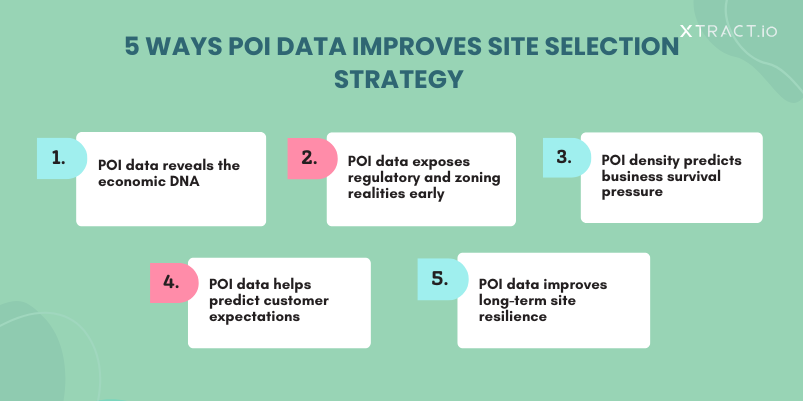
1. POI data reveals the economic DNA
Every area has an economic personality, and these personalities can be revealed during site selection analysis by examining the types of businesses that succeed in a neighborhood. Businesses such as professional services, discount retailers, specialty stores, and medical facilities can tell more about price sensitivity, purchasing behavior, and economic stability. Such business location analysis does not need to rely solely on income statistics.
For example, an area dominated by repair shops, second-hand stores, and value retailers often reflects cost-conscious consumer behavior. Demographics tell businesses what people can afford. POI composition tells what they actually choose to spend money on.
| Tip: Before finalizing a site, businesses should group nearby POIs by business type and longevity. A cluster of long-standing service businesses is often a stronger indicator of economic health than new developments. |
2. POI data exposes regulatory and zoning realities early
Another reason site selection strategy often fails is that regulatory friction is discovered too late. Regulatory frictions may look manageable on paper, but they become challenging once businesses try to operate.POI data serves as an indicator in the initial stages of site selection strategy planning, aiding in addressing zoning, licensing, and compliance restrictions.
Since business categories tend to cluster in areas where regulations support their operations, understanding neighborhood-level details can help in this case. For example, if many childcare centers, clinics, or educational institutions are in the same neighborhood, it usually means zoning approvals are navigable. Also, a noticeable absence of alcohol-serving locations or medical facilities may hint at licensing complexity or community resistance.
Instead of learning about restrictions during legal review (after time and money are spent), POI patterns give businesses an early warning.
| Tip: Look for what’s missing, not just what’s present. Absence of certain POIs can be just as informative as dense clustering. |
3. POI density predicts business survival pressure
Businesses should assess competition not only by the number of local competitors but also by understanding the deeper operational pressures that a market sustains. POI data helps bridge this gap because it reveals
- How crowded is an area with similar businesses?
- What pricing and format competition exists in the area?
- Where demand seems to cluster based on nearby activity?
- How hard would a new player need to work to stand out?
- Whether businesses in the area tend to stick around or churn quickly.
Though POI data reveals such information, a dense cluster of similar businesses isn’t always bad. It could point to strong demand or signal a saturated market with thin margins.
| Tip: The strongest sites balance competition with diversity. These sites have businesses with nearby places that can support or boost each other, and also allow for steady purchases. So, during site evaluation, calculate the category diversity ratio within a defined radius. |
4. POI data helps predict customer expectations
Customers develop expectations based on their surroundings as the POIs in the neighborhood influence the service expectations, pricing tolerance, and brand perception.
For example, if an area is surrounded by premium wellness centers, specialty retailers, and boutique services, then it sets a higher expectation for experience and quality. Even if demand exists, a mismatch between the brand positioning and surrounding POIs can silently erode performance.
| Tip: A handful of high-end places can also quietly raise expectations for everything around them, even without attracting the same customers. So, businesses should not ignore premium neighbors. |
5. POI data improves long-term site resilience
Most site selection focuses on opening performance. POI data helps businesses think about years three, five, and ten. Tracking changes in POI data over time reveals:
- Emerging business categories
- Declining sectors
- Signs of economic transition
If an area gradually shifts from industrial services to creative studios, healthcare, or education, that signals changing demand patterns.
A location that appears average today but shows positive POI growth often outperforms a “hot” location that has already peaked.
| Tip: When planning for site selection strategy, it is best to examine historical POI snapshots instead of only current data. Stability and gradual change are preferable to volatility. |
Final thoughts
When used deeply, POI data helps businesses to understand how money flows, regulation behaves, customers think, and environments evolve.
It moves site selection away from instinct and toward situational intelligence. If you’re still using POI data just to “see what’s nearby,” you’re leaving most of its value on the table. And in site selection, nuance is often the difference between a good location and a high-performing one.
If you want to move beyond surface-level business location analysis and turn location data into a real strategic advantage, xtract.io can help.